



Photo by Nishinocchi on Photo AC
Hydrogen‑related companies remain priced as undervalued “future options” despite their long‑term technological upside.
Exhibit: Market Valuation Gap Between Hydrogen and Non‑Hydrogen Companies
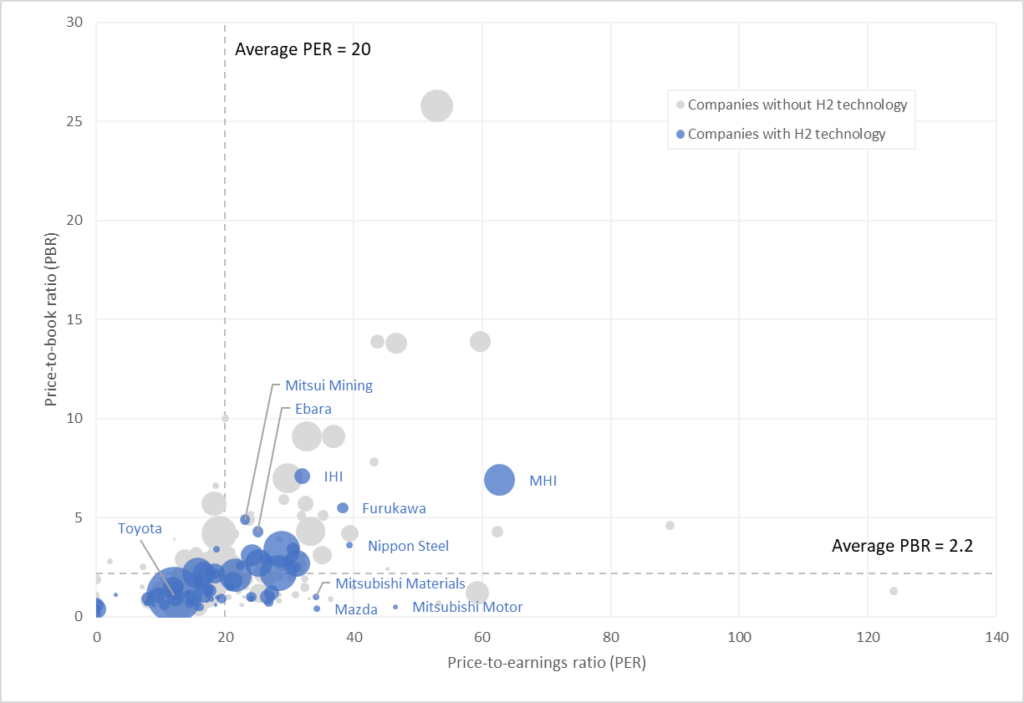
Notes: Price-to-book ratio (PBR) compares a company’s market value with the book value of its net assets, indicating how much investors are willing to pay relative to the firm’s underlying equity. Lower PBRs often signal undervaluation or structural challenges, while higher PBRs reflect strong confidence or expected future growth. Price-to-earnings ratio (PER) measures how expensive a stock is relative to its current earnings, showing how much investors pay for one unit of profit. Companies with low PERs are typically viewed as value stocks with limited near‑term growth expectations, whereas high‑PER firms are seen as having stronger growth prospects or higher investor optimism.
How the Market Values Hydrogen Technology Today
The H2 & FC EXPO Spring 2026, held from March 17 to 19, showcased the rapid evolution and expanding scope of the hydrogen industry. Technologies across the entire value chain—production, transport, storage, and end‑use—were presented in one place, making it clear that hydrogen is transitioning from concept to industrial reality. At the same time, the excitement at the exhibition contrasted sharply with how the stock market appears to value hydrogen‑related companies. To visualize this gap, the following scatter plot analysis was conducted.
The chart highlights a clear divergence in market valuation between companies with hydrogen technologies (blue) and those without (gray). Hydrogen‑related firms cluster below the average PER and PBR lines, indicating that their shares are priced cheaply relative to earnings and book value. Heavy industry, materials, and infrastructure companies—many of which possess meaningful hydrogen capabilities—appear particularly undervalued. Although these firms hold substantial technological potential for future hydrogen demand, their current earnings contribution from hydrogen remains limited, prompting investors to adopt a cautious stance.
In contrast, non‑hydrogen companies are widely distributed across higher PER and PBR ranges, reflecting stronger market confidence in their growth prospects and brand strength. This distribution illustrates a structural divide: hydrogen companies are treated as value stocks, while non‑hydrogen companies are viewed as growth stocks. Hydrogen remains a long‑term strategic theme, but near‑term monetization challenges mean investors still regard it as a “future option” rather than a present driver of earnings. As a result, hydrogen‑related firms appear undervalued today yet carry significant thematic upside—an intriguing duality that the chart brings clearly into focus.
Japanese translations
Title: 水素の現実と市場認識:H2 & FC EXPO 2026が示した評価ギャップ
Exhibit: 水素関連企業と非水素企業の市場評価ギャップ
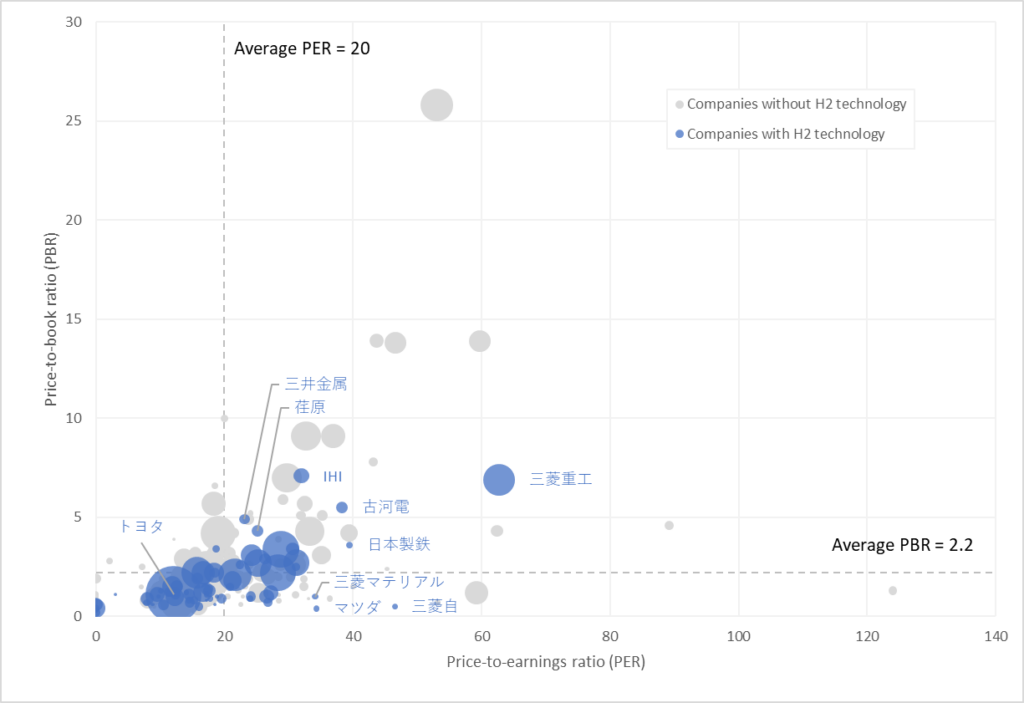
【注記】株価純資産倍率(PBR)は、企業の時価総額を純資産の簿価と比較する指標であり、投資家が企業の基礎的な資本に対してどれだけの価値を支払う意思があるかを示します。PBR が低い場合は、割安評価や構造的課題を示唆することが多く、逆に高い PBR は強い市場信頼や将来の成長期待を反映します。株価収益率(PER)は、企業の現在の利益に対して株価がどれほど割高かを測る指標であり、投資家が1単位の利益に対してどれだけ支払うかを示します。PER が低い企業は、短期的な成長期待が限定的なバリュー株として見られ、高い PER の企業は、より強い成長期待や投資家の楽観を反映した銘柄とみなされます。
3月17〜19日に開催された H2 & FC EXPO【春】~第25回[国際]水素・燃料電池展~ は、水素産業の広がりと技術進化を強く感じさせるイベントだった。製造から輸送、貯蔵、利用まで、バリューチェーン全体の技術が一堂に集まり、水素がすでに実用段階へと踏み出していることが明確になった。一方で、展示会の熱気とは裏腹に、株式市場が水素関連企業をどのように評価しているのかには大きなギャップがあるように感じられた。そのギャップを可視化するために、今回の散布図分析を行った。
散布図が示しているのは、水素技術を持つ企業(青)と持たない企業(灰色)で、市場からの評価のされ方が明確に異なるという構図だ。青い点は全体として PER・PBR の平均ラインより下側に集まり、利益や資産価値に対して株価が割安に放置されている傾向が強い。特に重工・素材・インフラ系の水素企業は、将来の水素需要拡大に向けた技術ポテンシャルを持ちながらも、現時点では収益貢献が限定的で、市場が慎重に評価していることが読み取れる。
一方で、非水素企業は高PER・高PBRの領域にも幅広く分布し、成長性やブランド力で評価される企業が多い。つまりこのチャートは、水素企業=バリュー寄り、非水素企業=成長株寄りという市場の構造を可視化していると言える。水素は長期テーマである一方、短期的な収益化が難しいため、投資家はまだ“将来のオプション価値”として扱っている。結果として、水素企業は割安に見えるが、長期的にはテーマ性が強いという二面性を持つことが、この図から端的に浮かび上がっている。