


A geological energy source that requires no manufacturing process, self-recharges like a renewable, and costs a fraction of green hydrogen is moving from scientific curiosity to active investment thesis. Here is what the data say — and what remains unproven.
Geological Hydrogen
Beneath the surface of a village 60 km from Bamako, Mali, a well has been supplying electricity continuously since 2012 — from hydrogen gas that seeps naturally from the earth at 97–98% purity, at an estimated production cost of $0.50/kg.1,2,3 That single data point is both the foundation of an emerging industry and the source of its greatest uncertainty. Natural hydrogen — also called white hydrogen or geologic hydrogen — forms through geological processes in the Earth’s crust and can, in principle, be extracted directly from the ground, much like natural gas.4 Unlike green hydrogen, which requires electrolyzers powered by renewable electricity, or blue hydrogen, which relies on carbon capture applied to fossil-fuel reforming, natural hydrogen requires no industrial production process at all. The Mali well, operated by Hydroma Inc., has not experienced pressure decline in over a decade of production — strong geochemical evidence that the reservoir is continuously replenished through ongoing serpentinization reactions at depth,1,5 giving it a quasi-renewable character that no other hydrogen pathway can claim.
Comparison of Estimated H2 Production Costs
| Hydrogen Type | Estimated Cost ($/kg) | Carbon Intensity | Maturity |
| Grey (SMR, no CCS) | $0.5–2.0 | High (9–12 kg CO₂e/kg H₂) | Mature, dominant today |
| Blue (SMR + CCS) | $1.5–3.0 | Low–medium (~2–4 kg CO₂e/kg H₂) | Scaling up |
| Green (electrolysis) | $3.0–8.0 | Near-zero (RE-powered) | Early commercial |
| White / Natural | $0.5–1.5 (projected) | Very low (~0.4–1.5 kg CO₂e/kg H₂) | Pre-commercial (Mali only) |
Notes: Cost estimates: Grey & Blue — IEA Global Hydrogen Review 2023, IRENA 2022, BloombergNEF 2023; Green — IEA GHR 2025, Petersen 2025.6,7 White hydrogen: Rystad Energy 2024 (Hydroma realized cost $0.50/kg); Petersen 2025 (€0.75–1/kg European estimate).7,8 Carbon intensity: Bhandari et al. 2014, Antonini et al. 2020, IPCC AR6 WG III; white H₂: Brandt 2023, Joule. Maturity assessments: IEA GHR 2024/2025, Hydrogen Science Coalition 2025.6,9
Generation mechanism
The science underpinning natural hydrogen is well-established, even if its commercial applicability is not. Three geochemical pathways — serpentinization of iron-rich ultramafic rock, radiolysis driven by radioactive decay in ancient granite, and thermolysis from deep-crustal heat — account for virtually all known occurrences, with serpentinization responsible for an estimated 80% of them.10,11
Three geochemical pathways
| Mechanism | Key Reaction | Optimal Conditions | Key Locations |
| Serpentinization | Iron-rich ultramafic rock + H₂O → H₂ + serpentine minerals | 150–400 °C; fractured/faulted terrain | Precambrian cratons, ophiolites, mid-ocean ridges |
| Radiolysis | Uranium / Thorium / Potassium radioactive decay → ionizing radiation splits H₂O → H₂ | Ancient granitic basement, long residence times (100 Ma+) | Archean shields, uranium-rich granite provinces |
| Deep source / thermolysis | High-Pressure, high-Temperature mantle degassing or organic pyrolysis at depth | > 200 °C; deep fault conduits | Volcanic arcs, deep rift zones, hot-spot settings |
Notes: Serpentinization of ultramafic rocks involves two key pathways. Mg‑rich olivine (forsterite) reacts with water without producing hydrogen, following the classic hydration reaction 2 Mg₂SiO₄ + 3 H₂O → Mg₃Si₂O₅(OH)₄ + Mg(OH)₂, forming serpentine minerals and brucite. In contrast, Fe‑rich olivine (fayalite) drives hydrogen‑producing redox reactions, most commonly represented by 3 Fe₂SiO₄ + 2 H₂O ⇌ 3 SiO₂ + 2 Fe₃O₄ + 2 H₂, where Fe²⁺ is oxidized to magnetite (Fe₃O₄), water is reduced to H₂, and silica is released as SiO₂. Radiolysis refers to the production of hydrogen when ionizing radiation from the natural decay of uranium, thorium, and potassium interacts with water. The radiation splits water molecules according to the primary reaction H₂O → H• + OH•, generating hydrogen and hydroxyl radicals. Molecular hydrogen is then formed through radical recombination, most simply expressed as 2 H• → H₂. Overall, radioactive decay produces ionizing radiation that drives the net transformation H₂O → H₂ plus oxidized species such as OH• and H₂O₂, making radiolysis a viable natural source of geologic hydrogen in the subsurface. Sources: Ballentine et al. (2025) [10] — principal comprehensive review covering all three mechanisms. Sherwood Lollar et al. (2014) [11] — foundational quantification of H₂ production rates from serpentinization and radiolysis. Warr et al. (2019) [12] — radiolysis accumulation rates and residence times in Precambrian shield environments. Royal Society (2025) [13] — notes that deep-source/mantle origin models lack supporting evidence; commercially relevant targets are within the crust.10,11,12,13
A 2024 USGS model estimated that thousands to billions of megatons of hydrogen may reside in the Earth’s crust, enough at even a small recoverable fraction to meet projected global hydrogen demand for centuries.14,15 However, the same study was careful to note that most subsurface hydrogen is likely inaccessible due to depth, location, or reservoir size. The Royal Society’s June 2025 policy briefing, authored by an international working group chaired by Professor Barbara Sherwood Lollar of the University of Toronto, added a further caution: the published global occurrence map largely reflects where systematic exploration has taken place — not where hydrogen definitively exists or does not.13 Eastern Europe’s apparent richness in occurrences is a Soviet-era exploration artifact. Japan and much of Southeast Asia appear blank not because they lack hydrogen, but because no one has systematically looked.4,13
Published occurrences of primarily free-gas hydrogen (>10%) globally.
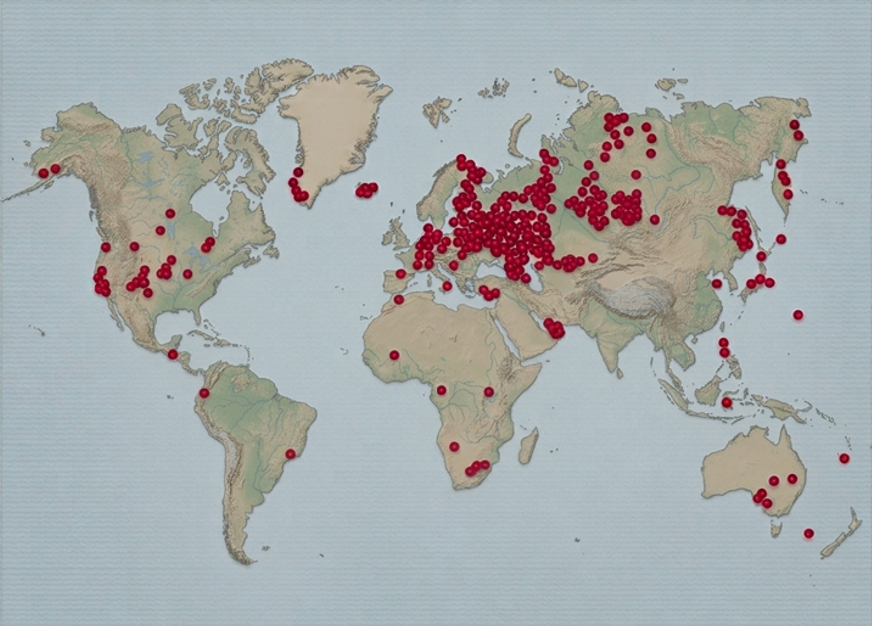
Source: Oxford Institute of Energy Studies (OIES, 2024); adapted from Zgonnik (2020). Reproduced from: The Royal Society (2025). Natural hydrogen: future energy and resources. Policy Briefing. ISBN 978-1-78252-782-4.
Domestic Initiatives (Japan)
The Japanese archipelago sits on a convergent plate boundary — geologically active, but lacking the vast exposures of Precambrian ultramafic rock that underpin the world’s most productive natural hydrogen targets in West Africa, Australia, and the US Midcontinent.4,13 Japan’s structural geological disadvantage is real. Yet in May 2025, NEDO — the New Energy and Industrial Technology Development Organization — formally adopted Japan’s first government-funded natural hydrogen geological assessment program, a joint project by Kyushu University and Kyushu Electric Power focused on fault-associated hydrothermal systems in the Kyushu region.16,17 Preliminary results are expected by 2027–2028 and will serve as a make-or-break milestone for domestic ambitions.
In the meantime, Japanese corporates have moved faster on the international stage: Mitsubishi Heavy Industries co-led a $50 million Series B extension in Koloma in October 2024.18,19,20 Then in July 2025, Toyota, MHI, and ENEOS Xplora made a strategic equity investment in Gold Hydrogen Ltd (ASX: GHY) at a 22% premium to market — a signal that at least three major Japanese industrial groups have concluded natural hydrogen represents a credible near-term commercial prospect, not a speculative sideshow.21
Japanese Corporate Landscape
| Organization | Stage | Activity | Notes |
| Kyushu University + Kyushu Electric Power (9508) | Research | NEDO Frontier R&D (adopted May 2025): geological potential assessment, Kyushu region | Earliest funded natural-H₂ research program in Japan; results expected 2027–2816,17 |
| ENEOS XPlora (5020) | Survey | NEDO Geologic Hydrogen program participation; domestic geological survey | Leveraging existing O&G exploration expertise28 |
| Mitsubishi Heavy Industries (7011) | Early investment | Co-led $50M Series B extension in Koloma (Oct 2024) alongside Osaka Gas | Strategic technology-access play; MHI is Japan’s most advanced in the space18,19,20 |
| Osaka Gas (9532) | Early investment / Survey | Co-investor in Koloma; domestic pipeline integration study | Interest in distributed H₂ for city-gas network decarbonization18,19 |
| Air Water (4088) | Survey | Initial domestic geological survey | Industrial gas company exploring supply diversification28 |
| Kanto Natural Gas Development | Survey | Initial domestic survey | Existing natural-gas infrastructure could support future H₂ integration28 |
Sources were organized by organization to highlight differences in evidentiary strength. High‑reliability cases are those supported by multiple independent disclosures: MHI is confirmed through its own corporate press release, Koloma’s official statements, reporting by Canary Media, and Gold Hydrogen’s filings with the Australian Securities Exchange. Osaka Gas is supported by two independent sources—Koloma’s official materials and Canary Media reporting. Kyushu University and Kyushu Electric Power are validated through official documentation from Japan’s New Energy and Industrial Technology Development Organization (NEDO) and institutional press releases issued by the university and the utility. In contrast, ENEOS XPlora, Air Water, and Kanto Natural Gas Development rely primarily on analytical descriptions in Section 2.3 of the original report and an article published by GasWorld, without independent corporate disclosures. For these organizations, external summaries or blogs should explicitly cite the Natural Hydrogen Report 2026 (March 2026) as the source.
International Initiatives
Gold Hydrogen’s Ramsay Project on South Australia’s Yorke Peninsula is currently the most data-rich natural hydrogen exploration program outside Mali. The Ramsay 3 well, completed in December 2025, confirmed hydrogen purity of up to 97%, with helium concentrations at the wellhead previously recorded at up to 36.9% — believed to be the highest ever measured globally.22,23 That helium co-production matters economically: at approximately $450 per Mcf and with demand growing from semiconductor, MRI, and space applications, high-purity helium effectively subsidizes hydrogen extraction costs and changes the project economics fundamentally.
In the United States, Koloma has drilled its Twin Peaks 1W test well in Canyon County, Idaho, at 3,658 meters depth, with results still pending public disclosure as of March 2026.24,25 The company has raised $403 million in total funding but has declined to provide specific well data, citing commercial confidentiality — a posture that has attracted scrutiny from industry analysts at GeoExpro and S&P Global.25,26 Whether Koloma’s silence reflects strategic discretion or disappointing results is the sector’s most-watched open question. Alongside these developments, the IEA’s Hydrogen Technology Collaboration Programme formally launched Task 49: Natural Hydrogen in 2024, convening 31 experts from 16 countries — the clearest institutional signal yet that natural hydrogen is no longer a fringe topic.27
Global Corporate Landscape
| Entity | Region | Stage | Geology / Asset | Key Financials & Policy |
| Hydroma1,2,3,8 | Mali | Commercial | Precambrian craton; dolomite reservoir (100–1,500 m); H₂ 97–98%, self-recharging; 24 wells | Est. production cost $0.50/kg; Pegasus Capital-backed; world’s only commercial producer |
| Gold Hydrogen (ASX: GHY)21,22,23 | South Australia | Pilot / appraisal | Cambrian limestone + granite basement, Yorke Peninsula; Ramsay 3: H₂ up to 97%, He up to 36.9%; 1.3 Mt prospective resource | ASX-listed; strategic investment from Toyota, MHI, ENEOS (Jul 2025); SA government grants; CSIRO partnership |
| Koloma18,19,24,25,26 | USA (KS, IA, ID) | Pilot / appraisal | Mid-Continent Rift; mafic/ultramafic rocks; Idaho Twin Peaks 1W: 3,658 m test well (Nov 2025) | $403M raised (BEV-Bill Gates, Amazon, UAL, MHI, Osaka Gas); IRA PTC applicability under review |
| HyTerra (ASX: HYT)29 | USA / Australia | Pilot / appraisal | Nemaha Ridge, Kansas; H₂ >90%, He ~3% | ASX-listed; co-production of high-value helium diversifies revenue |
| 45-8 Energy30 | Europe | Survey | Multiple European craton targets; France mining-code reform (2023) | EU Hydrogen Strategy alignment; France first exploration permit Dec 2023 |
| Snowfox Discovery (BP Ventures, Rio Tinto)29 | UK / global | Early investment | AI-driven geologic H₂ exploration platform | BP Ventures led Series A (Jan 2025); Rio Tinto, Oxford Science Enterprises co-invested |
Sources: The company profiles and financial data in this analysis are drawn from the Natural Hydrogen Report 2026 (March 2026) and the following primary sources. Hydroma: Hydroma Inc. corporate disclosures (hydroma.ca, 2024) and Rystad Energy, “The white gold rush and the pursuit of natural hydrogen” (March 2024, rystadenergy.com). Gold Hydrogen (ASX: GHY): ASX release confirming Ramsay 3 results (December 2, 2025, via fuelcellsworks.com); Gold Hydrogen helium testing update (goldhydrogen.com.au, 2024); and Key Facts Energy coverage of the Toyota/MHI/ENEOS Xplora investment (July 4, 2025, keyfactsenergy.com). Koloma: Koloma press release, “Koloma Partners with Mitsubishi Heavy Industries and Osaka Gas” (October 15, 2024, koloma.com); Canary Media (October 17, 2024, canarymedia.com); S&P Global, “Geologic hydrogen explorer Koloma, with $400 mil in funding, quiet on next step” (January 24, 2025); Van Trump Report (December 12, 2025); and GeoExpro, “The Koloma Enigma” (November 10, 2025). HyTerra (ASX: HYT), Natural Hydrogen Energy, 45-8 Energy, H2Au, Snowfox Discovery, and Fortescue: sector overview drawn from Squatex, “The Evolution of White Hydrogen: Technological Advances and Regulatory Changes” (November 21, 2025, squatex.com); OilPrice.com, “White Hydrogen Emerges as a Wild Card in the Global Clean Energy Race” (January 4, 2026); and GasWorld, “Will natural hydrogen make real strides in 2026?” (January 7, 2026, gasworld.com). French regulatory developments: referenced in the Natural Hydrogen Report 2026, Section 3.5. All data reflects publicly available information as of March 2026 and does not constitute investment advice.
Emerging Stories to Watch
The honest assessment is that natural hydrogen sits at an inflection point where the upside is extraordinary and the uncertainty is proportionate. The cost advantage over every other low-carbon hydrogen pathway is compelling on paper — but it derives almost entirely from a single shallow, high-purity, self-recharging reservoir in Mali that produces roughly as much hydrogen per year as a large electrolyzer runs in a week.1,3,8 Every other project is in exploration or pilot stage. Flow-test results from Ramsay 4/5 and HyTerra’s Nemaha Ridge assessment in Kansas — both expected in 2026 — will do more to define the sector’s trajectory than any amount of modeling.29
For sustainability-focused analysts and investors, the key variables to track are: (1) whether self-recharging reservoir behavior replicates outside Mali at commercially relevant scales;1,5 (2) the IRA Production Tax Credit eligibility determination for geologic hydrogen in the United States;18 (3) the NEDO geological findings from Kyushu (2027–2028);16,17 and (4) whether Japan moves to amend its Mining Act to create an explicit exploration licensing framework — the regulatory step France took in 2023 that has already produced the continent’s first exploration permit.30
The global market for natural hydrogen is projected at $8.81 billion by 2033, growing at a 9.6% CAGR.31,32 Whether that trajectory reflects genuine commercial production or extended exploration activity will be determined in the next three years.
Disclaimer: This report is prepared for informational purposes only based on publicly available information and does not constitute investment advice. Information is current as of March 2026 and may be superseded by subsequent exploration results, corporate announcements, or policy changes. Readers should conduct independent due diligence before making investment or business decisions. Natural hydrogen exploration remains highly speculative; all forward-looking estimates are subject to significant uncertainty.
Japanese translations
Title: 地質学的水素(ナチュラル水素)とは
マリの首都バマコから60kmの村の地下では、2012年から現在まで途切れることなく電力が供給されている。その源は、純度97〜98%の水素ガスが地中から自然に湧き出す一本の井戸であり、推定生産コストは0.50ドル/kgとされる。このたった一つのデータポイントが、新興産業の礎であると同時に、最大の不確実性の源となっている。ナチュラル水素(白色水素・地質水素とも呼ばれる)は、地球の地殻内で地質学的プロセスによって生成される分子状水素であり、天然ガスと同様に地中から直接採掘できる可能性がある。再生可能電力による電解槽を必要とするグリーン水素や、化石燃料改質に炭素回収を組み合わせるブルー水素とは異なり、ナチュラル水素には工業的な製造プロセスが一切不要だ。Hydroma Inc.が操業するマリの井戸は、10年以上の生産を経ても坑口圧力が低下していない。これは、深部で継続する蛇紋岩化反応によって貯留層が常時補充されているという強力な地球化学的証拠であり、他のいかなる水素製造経路も主張できない「準再生可能」という特性を与えている。
H₂生産コスト比較
| 水素種別 | 推定コスト($/kg) | 炭素強度 | 成熟度 |
|---|---|---|---|
| グレー(SMR、CCSなし) | $0.5–2.0 | 高(9–12 kg CO₂e/kg H₂) | 成熟・現在主流 |
| ブルー(SMR+CCS) | $1.5–3.0 | 低〜中程度(約2–4 kg CO₂e/kg H₂) | スケールアップ中 |
| グリーン(電気分解) | $3.0–8.0 | ほぼゼロ(再エネ電力使用) | 商業化初期 |
| ホワイト/ナチュラル | $0.5–1.5(推定) | 非常に低い(約0.4–1.5 kg CO₂e/kg H₂) | 商業化前(マリのみ) |
注記:グレー・ブルー水素のコストはIEA Global Hydrogen Review 2023、IRENA 2022、BloombergNEF 2023に基づく。グリーン水素はIEA GHR 2025およびPetersen(2025, Sustainability)を参照。ホワイト水素のコストはRystad Energy(2024)によるHydromaの実績値0.50$/kgと、Petersen(2025)による欧州向け推計€0.75–1/kgに基づく。炭素強度はBhandari et al.(2014)、Antonini et al.(2020)、IPCC AR6 WG III Table 11.4を参照。ホワイト水素の炭素強度はBrandt(2023, Joule)——ナチュラル水素のライフサイクルGHGを初めて査読論文で定量化——に基づく。成熟度評価はIEA GHR 2024/2025、Hydrogen Science Coalition(2025)、およびHydromaの操業データを参照。
生成メカニズム
ナチュラル水素を支える科学は確立されている——商業的な実用可能性はともかくとして。蛇紋岩化(鉄分を含む超苦鉄質岩の反応)、放射線分解(古代花崗岩中の放射壊変による)、深部起源/熱分解(深部地殻熱による)という3つの地球化学的経路が、既知の発生事例のほぼすべてを説明しており、蛇紋岩化だけで推定80%を占める。
3つの地球化学的経路
| メカニズム | 主要反応 | 最適条件 | 主要産地 |
|---|---|---|---|
| 蛇紋岩化 | 鉄分に富む超苦鉄質岩 + H₂O → H₂ + 蛇紋石鉱物 | 150–400℃;破砕・断層帯 | 先カンブリア楯状地、オフィオライト、中央海嶺 |
| 放射線分解 | U/Th/Kの放射壊変 → 電離放射線がH₂Oを分解 → H₂ | 古代花崗岩基盤;長い滞留時間(1億年以上) | 始生代楯状地、ウラン質花崗岩地域 |
| 深部起源/熱分解 | 高温高圧下のマントルガス放出または有機物の深部熱分解 | 200℃超;深部断層 | 火山弧、深部リフト帯、ホットスポット |
注記(蛇紋岩化):超苦鉄質岩の蛇紋岩化には2つの経路がある。Mg質かんらん石(フォルステライト)は水と反応して蛇紋石と水酸化マグネシウムを生成するが、水素は産生しない。一方、Fe質かんらん石(ファイアライト)は 3Fe₂SiO₄ + 2H₂O ⇌ 3SiO₂ + 2Fe₃O₄ + 2H₂ の反応でH₂を生成し、Fe²⁺がマグネタイト(Fe₃O₄)に酸化される。注記(放射線分解):U・Th・Kの放射壊変から発生する電離放射線が水分子をH• とOH•に分解し、2H• → H₂ のラジカル再結合により水素が生成される。出典:RS-10(Ballentine et al., 2025, Nature Reviews Earth & Environment)が3メカニズム全体の主要レビュー論文。RS-16(Sherwood Lollar et al., 2014, Nature)が蛇紋岩化・放射線分解の速度定量の基礎文献。RS-9(Warr et al., 2019, Chemical Geology)が放射線分解に特化した先カンブリア楯状地の実測データを提供。RS-1(Royal Society, 2025)は深部起源/マントル起源説の根拠が不十分であることを明示し、商業的に有望なターゲットは地殻内にあると指摘している。
2024年のUSGSモデルは、地球地殻内に数千〜数十億メガトンの水素が存在する可能性を推計しており、ごく一部が回収可能であるだけで数世紀分の世界需要を賄える規模となる。ただし同研究は、ほとんどの地下水素は深度・立地・貯留層規模の観点からアクセス不能である可能性が高いと慎重に注記している。トロント大学のBarbara Sherwood Lollar教授を委員長とする国際作業部会が執筆したThe Royal Societyの2025年6月の政策ブリーフィングは、さらに重要な留保を加えている——公表されている世界発生マップは、水素が確実に存在する・しないことを示すものではなく、系統的な探査が行われた地域を反映しているに過ぎない。東欧での発見事例の多さはソビエト時代の探査活動の産物であり、日本や東南アジアの大半が「空白」に見えるのは水素が存在しないからではなく、誰も系統的に探していないからである。
世界各地で報告されている、主として遊離ガスとして存在する水素(濃度10%超)の産出事例
地図出典:Oxford Institute of Energy Studies(OIES, 2024);Zgonnik(2020)をもとに改変。The Royal Society(2025)Natural hydrogen: future energy and resources. Policy Briefing. ISBN 978-1-78252-782-4より転載。
国内の動向
日本列島はユーラシア・太平洋・フィリピン海の各プレートが収束する境界に位置しており、地質学的に活発である一方、西アフリカ・オーストラリア・米国中央部の主要産地を支える広大な先カンブリア超苦鉄質岩の露出に乏しい。日本の地質学的不利は現実のものだ。しかし2025年5月、NEDO(新エネルギー・産業技術総合開発機構)は、九州大学と九州電力(9508)による九州地域の断層関連熱水系を対象とした地質ポテンシャル評価プログラムを正式採択した——日本初の政府資金によるナチュラル水素地質調査プログラムである。予備的結果は2027〜2028年に示される見通しで、国内事業の成否を左右するマイルストーンとなる。
一方、日本企業は国際舞台でより速い動きを見せている。三菱重工(7011)は2024年10月、Koloma(ビル・ゲーツのBreakthrough Energy Ventures・Amazon・ユナイテッド航空等が出資する米国のAI駆動型地質水素探査企業)の5,000万ドルシリーズB増資を大阪ガスとともに主導した。さらに2025年7月にはトヨタ(7203)・MHI(7011)・ENEOS XPlora(5020)が市場価格に対し22%のプレミアムでGold Hydrogen Ltd(ASX: GHY)に戦略的出資を行った——少なくとも3つの日本の主要産業グループが、ナチュラル水素を投機的な話題ではなく、近未来の商業的見通しを持つテーマと判断したシグナルである。
日本企業の動向
| 組織 | ステージ | 活動内容 | 備考 |
|---|---|---|---|
| 九州大学 + 九州電力(9508) | 研究 | NEDOフロンティア研究開発(2025年5月採択):九州地域の地質ポテンシャル評価 | 日本初の政府資金によるナチュラル水素研究プログラム;結果は2027〜28年見込み |
| ENEOS XPlora(5020) | 調査 | NEDOジオロジック水素プログラム参加;国内地質調査 | 既存の石油・ガス探査ノウハウを活用 |
| 三菱重工(7011) | 初期投資 | 大阪ガスとともにKolomaの5,000万ドルシリーズB増資を主導(2024年10月) | 技術アクセスを目的とした戦略的投資;日本企業の中で最も先行 |
| 大阪ガス(9532) | 初期投資/調査 | Kolomaへの共同出資;国内パイプライン統合検討 | 都市ガスネットワークの脱炭素化に向けた分散型H₂への関心 |
| エア・ウォーター(4088) | 調査 | 国内地質調査(初期) | サプライ多様化を模索する産業ガス企業 |
| 関東天然瓦斯開発 | 調査 | 国内調査(初期) | 既存の天然ガスインフラが将来のH₂統合を支援できる可能性 |
出典:MHIは自社プレスリリース・Koloma公式発表・Canary MediaおよびGold HydrogeのASX開示という複数の独立したソースで確認できる。大阪ガスはKoloma公式とCanary Mediaの2ソースで裏付けられる。九州大学・九州電力はNEDO公式資料および各機関のプレスリリースにより確認されている。一方、ENEOS XPlora・エア・ウォーター・関東天然瓦斯開発の国内調査活動は、元レポートのSection 2.3の分析記述とGasWorld記事(2026年1月7日)に基づくものであり、各社の独立した公開開示は確認されていない。これら3社に関する記述は Natural Hydrogen Report 2026(2026年3月)を出典として明示のうえ引用すること。
国際的な動向
南オーストラリア州ヨーク半島のGold HydrogenのRamsayプロジェクトは、マリ以外では現在最もデータが充実したナチュラル水素探査プログラムだ。2025年12月に完了したRamsay 3井は最大97%の水素純度を確認しており、坑口でのヘリウム濃度は過去の試験で最大36.9%を記録——世界最高水準と見られている。このヘリウム共産は経済的に重要な意味を持つ。半導体・MRI・宇宙産業からの需要増を背景に約450ドル/Mcfで取引されるヘリウムは、水素採掘コストを事実上補助し、プロジェクト経済性を根本的に変えうる。
米国では、KolomaがアイダホCanyonカウンティのTwin Peaks 1W試験井を深度3,658mまで掘削したが、2026年3月時点で結果は未公表のままだ。総額4億3百万ドルを調達した同社は、商業上の守秘義務を理由に具体的な坑井データの開示を拒んでおり、GeoExproやS&Pグローバルなど業界アナリストの注視を集めている。この沈黙が戦略的判断なのか、結果が芳しくないためなのかは、セクター最大の未解決問題だ。こうした動きと並行して、IEAの水素技術協力プログラムは2024年にTask 49「ナチュラル水素」を正式に発足させ、16カ国から31名の専門家を集結させた——ナチュラル水素がもはや辺縁的なテーマではないことを示す、これまでで最も明確な機関的シグナルである。
グローバル企業動向
| 企業・団体 | 地域 | ステージ | 地質/資産 | 財務・政策状況 |
|---|---|---|---|---|
| Hydroma | マリ | 商業生産 | 先カンブリアクラトン;ドロマイト貯留層(100〜1,500m);H₂ 97〜98%、自己再充填;24井 | 推定生産コスト$0.50/kg;Pegasus Capital出資;世界唯一の商業生産者 |
| Gold Hydrogen(ASX: GHY) | 南オーストラリア | パイロット/評価 | カンブリア紀石灰岩+花崗岩基盤、ヨーク半島;Ramsay 3: H₂最大97%、He最大36.9%;推定資源量1.3Mt | ASX上場;トヨタ・MHI・ENEOS戦略出資(2025年7月);SA州政府補助金;CSIRO連携 |
| Koloma | 米国(KS・IA・ID) | パイロット/評価 | 中部大陸リフト;苦鉄質・超苦鉄質岩;アイダホTwin Peaks 1W:深度3,658m試験井(2025年11月) | 累計調達額4億300万ドル(BEV-ビル・ゲーツ、Amazon、UAL、MHI、大阪ガス);IRA PTC適用可否審査中 |
| HyTerra(ASX: HYT) | 米国/オーストラリア | パイロット/評価 | カンザス州Nemaha Ridge;H₂ 90%超、He約3%;ASX初上場企業 | ASX上場;高価値ヘリウムの共産が収益を多様化 |
| Natural Hydrogen Energy | 米国(NE等) | パイロット | グレートプレーンズクラトン | 非上場;USGS賦存可能性データと連携 |
| 45-8 Energy | 欧州 | 調査 | 複数の欧州クラトンターゲット;フランス鉱業法改正(2023年) | EUの水素戦略と整合;フランス初の探査許可証 2023年12月 |
| H2Au | 南アフリカ/グローバル | 調査 | サハラ以南アフリカの各種クラトン | Geological Society of London会議共同主催(2024年) |
| Snowfox Discovery(BP Ventures、Rio Tinto) | 英国/グローバル | 初期投資 | AI駆動型地質水素探査プラットフォーム | BP VenturesがシリーズAをリード(2025年1月);Rio Tinto・Oxford Science Enterprises共同出資 |
| Fortescue(FMG) | オーストラリア | 初期投資 | モニタリング;ピルバラ鉄鉱床地質との潜在的シナジー | グリーン水素戦略との統合を検討中 |
出典:本分析における各社のプロファイルおよび財務データは、Natural Hydrogen Report 2026(2026年3月)および以下の一次資料に基づく。Hydroma:Hydroma Inc.企業開示資料(hydroma.ca、2024年)およびRystad Energy「The white gold rush and the pursuit of natural hydrogen」(2024年3月)。Gold Hydrogen(ASX: GHY):Ramsay 3結果に関するASX開示(2025年12月2日、fuelcellsworks.com経由);ヘリウム試験アップデート(goldhydrogen.com.au、2024年);トヨタ・MHI・ENEOS Xplora投資に関するKey Facts Energy報道(2025年7月4日)。Koloma:Koloma社プレスリリース(2024年10月15日);Canary Media(2024年10月17日);S&P Global(2025年1月24日);Van Trump Report(2025年12月12日);GeoExpro「The Koloma Enigma」(2025年11月10日)。HyTerra・Natural Hydrogen Energy・45-8 Energy・H2Au・Snowfox Discovery・Fortescue:Squatex「The Evolution of White Hydrogen」(2025年11月21日);OilPrice.com(2026年1月4日);GasWorld(2026年1月7日)。フランスの規制動向は Natural Hydrogen Report 2026 Section 3.5 を参照。すべてのデータは2026年3月時点の公開情報に基づき、投資助言を構成しない。
注目すべき今後の動向
率直に評価すれば、ナチュラル水素はアップサイドが非常に大きく、不確実性もそれに比例する変曲点に立っている。あらゆる低炭素水素経路に対するコスト優位性は理論上は compelling だが、その根拠は、大型電解槽が1週間で製造する量と同程度の水素を年間生産するマリの単一の浅い・高純度・自己再充填型貯留層から来るものに過ぎない。他のすべてのプロジェクトは探査またはパイロット段階にある。2026年に予定されるRamsay 4/5のフロー試験とHyTerraのカンザス州Nemaha Ridge評価の結果は、いかなるモデリングよりもこのセクターの軌道を左右するだろう。
サステナビリティ志向のアナリストや投資家が追うべきキー変数は以下の4点だ。
- マリ以外で、自己再充填型貯留層の挙動が商業的規模で再現されるか
- 米国における地質水素へのIRA生産税控除(PTC)適用可否の決定
- 九州からのNEDO地質調査の結果(2027〜2028年)
- 日本が鉱業法を改正し、ナチュラル水素の明示的な探査ライセンス制度を創設するか——フランスが2023年に踏み切り、すでに欧州初の探査許可証を生んだ規制上のステップ
ナチュラル水素のグローバル市場規模は2033年に88億1,000万ドル、CAGR 9.6%で成長すると予測されている。その軌道が真の商業生産を反映するものになるか、それとも長期にわたる探査活動にとどまるかは、今後3年間で決まる。
免責事項: 本レポートは公開されている情報に基づき作成したものであり、情報提供のみを目的とするもので、投資助言を構成するものではありません。記載内容は2026年3月時点の情報に基づいており、その後の探鉱結果、企業発表、政策変更等によって変更される可能性があります。投資判断や事業判断を行う際には、読者ご自身による独立した調査・検証を行ってください。天然水素の探鉱は依然として不確実性の高い分野であり、将来予測に関する記述は大きな不確実性を伴います。
(References)
1 Maiga, O., et al. (2023). Characterization of the spontaneously recharging natural hydrogen reservoirs of Bourakebougou in Mali. Scientific Reports, 13, 11696. doi:10.1038/s41598-023-38977-y
2 Prinzhofer, A., Cissé, C. S. T., & Diallo, A. B. (2018). Discovery of a large accumulation of natural hydrogen in Bourakebougou (Mali). International Journal of Hydrogen Energy, 43(42), 19315–19326. doi:10.1016/j.ijhydene.2018.08.193
3 Hydroma Inc. (2024). Activities – Natural Hydrogen & About Us – Our History.
4 Zgonnik, V. (2020). The occurrence and geoscience of natural hydrogen: A comprehensive review. Earth‑Science Reviews, 203, 103140. doi:10.1016/j.earscirev.2020.103140
5 Reitsma, M. (2022). The natural hydrogen field without pressure depletion. GeoExpro.
6 International Energy Agency (2024). Global Hydrogen Review 2024.
7 Petersen, T. (2025). White Hydrogen and the Future of Power‑to‑X: A Policy Reassessment of Europe’s Green Hydrogen Strategy. Sustainability, 18(1), 190. doi:10.3390/su18010190
8 Rystad Energy (2024, March 13). The white gold rush and the pursuit of natural hydrogen.
9 Hydrogen Science Coalition (2025, June). Everything you need to know about natural or geologic hydrogen.
10 Ballentine, C. J., et al. (2025). [Comprehensive review of geologic hydrogen generation mechanisms.] Nature Reviews Earth & Environment.
11 Sherwood Lollar, B., et al. (2014). [Quantification of H₂ production rates from serpentinization and radiolysis.] Nature.
12 Warr, O., et al. (2019). [Radiolysis‑derived H₂ accumulation rates and residence times in Precambrian shield environments.] Chemical Geology.
13 Royal Society (2025). Natural hydrogen: future energy and resources. Policy Briefing. ISBN 978‑1‑78252‑782‑4.
14 Ellis, G. S., & Gelman, S. E. (2024). Prospectivity Mapping for Geologic Hydrogen. USGS Professional Paper 1900. doi:10.3133/pp1900
15 U.S. Geological Survey (2025). Geologic Hydrogen – Science. USGS Central Energy Resources Science Center.
16 NEDO (2025). NEDO Frontier Research and Development Program – Geologic Hydrogen Projects. [Japanese]
17 Kyushu University / Kyushu Electric Power (2025). Research and Development towards Practical Application of Natural Hydrogen Resources in the Kyushu Region. NEDO Frontier R&D Adoption. [Japanese press release]
18 Koloma (2024, October 15). Koloma Partners with Mitsubishi Heavy Industries and Osaka Gas. Press Release.
19 Canary Media (2024, October 17). Koloma raises $50M more in quest to find natural hydrogen underground.
20 Mitsubishi Heavy Industries (2024, October 15). MHI Invests in Koloma, a US‑Based Geologic Hydrogen Exploration Startup. Press Release.
21 Gold Hydrogen Ltd. (2025, July 4). Toyota, Mitsubishi and ENEOS Xplora Invest in Gold Hydrogen. Key Facts Energy.
22 Gold Hydrogen Ltd. (2025, December 2). Gold Hydrogen Confirms Up to 97% Purity at Ramsay 3 Well as South Australia Drilling Completes. ASX Release.
23 Gold Hydrogen Ltd. (2024). Ramsay Project – Helium Testing Update. Company Release.
24 Van Trump Report (2025, December 12). The New Gold Rush for ‘Natural Hydrogen’… Koloma Drilling in Idaho.
25 GeoExpro (2025, November 10). The Koloma Enigma.
26 S&P Global (2025, January 24). Geologic hydrogen explorer Koloma, with $400 mil in funding, quiet on next step.
27 International Energy Agency (2024). Task 49: Natural Hydrogen. IEA Hydrogen Technology Collaboration Programme.
28 GasWorld (2026, January 7). Will natural hydrogen make real strides in 2026?
29 OilPrice (2026, January 4). White Hydrogen Emerges as a Wild Card in the Global Clean Energy Race.
30 Squatex (2025, November 21). The Evolution of White Hydrogen: Technological Advances and Regulatory Changes.
31 Grand View Research (2025). White Hydrogen Market Size, Share & Industry Report, 2033.
32 BCC Research / GlobeNewswire (2025, August 7).