


Fifteen years on, Japan has 15 reactors running again, TEPCO’s first unit back online since 2011, and its first new-build surveys underway — but the Chubu Electric data-falsification scandal reminds investors that governance, not technology, is the binding constraint.
Background
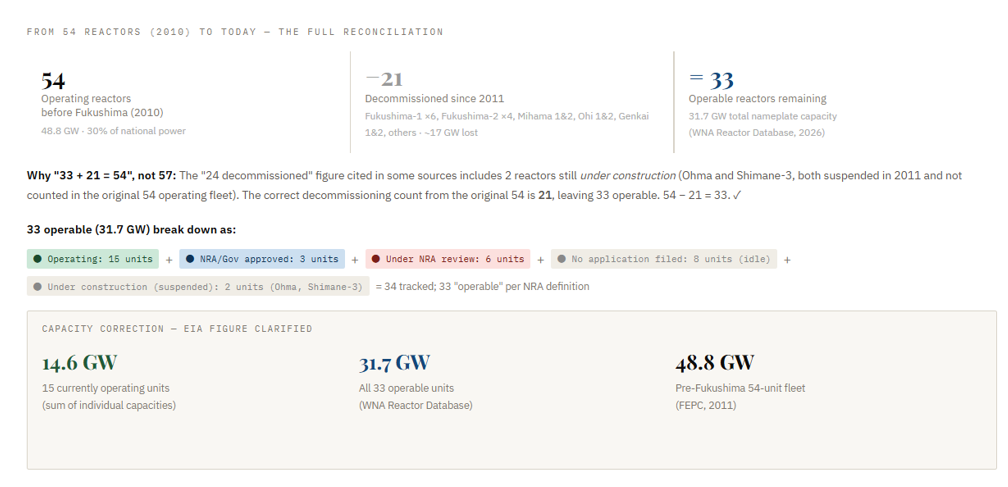
Before the March 2011 earthquake and tsunami, Japan operated 54 commercial reactors at 16 sites with a combined capacity of ~48.8 GW, supplying roughly 30% of national electricity.8 The government’s 2010 Strategic Energy Plan targeted raising nuclear’s share to 50% by 2030 — a level of ambition that current opinion polls suggest the Japanese public is again prepared to endorse. Following the Fukushima meltdowns all reactors were eventually shut down and, of the original 54, 21 have since been decommissioned (54 − 21 = 33 operable), including all six Fukushima Daiichi units, all four Fukushima Daini units, and eleven smaller ageing plants. Annual fossil-fuel import costs surged to over ¥10.7 trillion ($68bn) and household electricity bills rose nearly 20% by 2013.9 Policy reversed after 2022, driven by the Ukraine energy shock, surging electricity costs, and Japan’s 2050 carbon-neutrality commitment. The Cabinet’s 7th Strategic Energy Plan (February 2025) deleted the phrase “reduce nuclear dependency as much as possible” and replaced it with explicit “maximum utilisation” language — also permitting new reactor construction for the first time since 2011.1
Analysis
The most symbolically significant restart is Kashiwazaki-Kariwa Unit 6 (9 February 2026) — TEPCO’s first reactor to run since Fukushima, displacing an estimated 1.3 million tonnes of LNG annually.2 In western Japan, Kansai Electric’s seven-unit Fukui cluster (Mihama, Takahama, Ohi) anchors the fleet; Takahama Units 1&2 became the first reactors to receive a licence extension beyond 50 years, a legal precedent critical for reaching the 20% target. Eastern Japan re-joined in late 2024: Onagawa Unit 2 (October 2024) was the first BWR restart and the first eastern-Japan reactor; Shimane Unit 2 (December 2024) was the second BWR. In Hokkaido, Tomari-3 — NRA-approved July 2025 after a 12-year review, governor-endorsed December 2025 — targets restart in early 2027 pending seawall completion. Kansai Electric’s November 2025 geological surveys at Mihama for a next-generation SRZ-1200 reactor (MHI, 1,200 MW) marked Japan’s first concrete new-build step since 2011, though commercial operation is 20+ years away. Meanwhile, the Chubu Electric / Hamaoka data-falsification scandal (January 2026) was a structural shock: Chubu acknowledged deliberately selecting seismic waves to underestimate ground motion in NRA submissions since at least 2018, exposed only by an internal whistleblower. The NRA scrapped the entire safety screening and opened on-site inspections — revealing a systemic blind spot in that the regulator reviews only processed secondary data and cannot detect falsification without disclosure.7 The 7th SEP’s 2040 targets (renewables 40–50%, nuclear ~20%, thermal 30–40%) require approximately 30 reactors in operation — double today’s 15 — against a current nuclear share of just 9.4%.
Conclusions
Japan’s nuclear reversal is genuine and structurally backed: the removal of “reduce dependency” language from national energy policy, public opinion back near pre-Fukushima levels, TEPCO’s first restart in 15 years, and Kansai’s new-build surveys all mark a durable — not cyclical — change of direction. Yet the Hamaoka falsification case is a reminder that governance, not technology, is the binding constraint. If a major utility deceived the regulator for seven years undetected, every other safety submission is open to legitimate scrutiny. Japan’s nuclear revival will endure only if the industry and regulators close the data-integrity gap that Chubu Electric’s whistleblower exposed — because without credible safety governance, neither the new licence extensions, the new-build ambitions, nor the public opinion polls that now echo the pre-Fukushima era can be sustained.
Japanese translations
Title: 福島の影から20%目標へ──日本の原子力回帰
福島事故から15年、日本では15基の原子炉が再稼働し、東京電力は2011年以来初めて自社の原子炉を再び稼働させ、新設に向けた初の調査も始まった。しかし、中部電力のデータ改ざん問題は、投資家に対して「制約となっているのは技術ではなくガバナンスである」という現実を改めて突きつけている。
Background
2011年3月の地震と津波の前、日本は16サイトで54基の商業用原子炉を運転しており、合計出力は約48.8GWで、国内電力の約30%を供給していた。政府の2010年エネルギー基本計画では、2030年までに原子力の比率を50%へ引き上げることが目標とされていたが、現在の世論調査では日本国民が再びその水準を受け入れる姿勢を示している。福島事故後、すべての原子炉が停止し、元の54基のうち21基が廃炉となった(54 − 21 = 33基が運転可能)。廃炉には福島第一の6基、福島第二の4基、その他11基の老朽炉が含まれる。化石燃料の年間輸入額は10.7兆円を超え、家庭の電気料金は2013年までに約20%上昇した。2022年以降、政策は転換し、ウクライナ危機によるエネルギーショック、電力価格の高騰、そして日本の2050年カーボンニュートラル目標が背景となった。内閣が2025年2月に決定した第7次エネルギー基本計画では、「可能な限り原子力依存度を低減する」という文言が削除され、「最大限の活用」という表現に置き換えられ、2011年以来初めて新増設を認める方針が明確化された。
Analysis
最も象徴的な再稼働は、2026年2月9日の柏崎刈羽6号機であり、これは福島事故以来初めて東京電力の原子炉が稼働した事例で、年間約130万トンのLNG代替効果があると推計されている。西日本では、関西電力の福井クラスター(美浜・高浜・大飯の7基)が原子力 fleet の中心であり、高浜1・2号機は50年超運転の延長認可を受けた初の原子炉となり、2030年代の20%目標達成に不可欠な法的前例となった。東日本では2024年後半に再稼働が再開し、女川2号機(2024年10月)は初のBWR再稼働かつ東日本での最初の再稼働となり、島根2号機(2024年12月)が2例目となった。北海道では泊3号機が2025年7月にNRAの審査合格、同年12月に知事同意を得ており、防潮堤完成後の2027年初頭の再稼働を目指している。関西電力は2025年11月に美浜で次世代炉SRZ-1200(MHI製、1,200MW)の地質調査を開始し、2011年以来初めての新設に向けた具体的な一歩となったが、商業運転は20年以上先と見込まれる。
一方、中部電力・浜岡のデータ改ざん問題(2026年1月)は構造的な衝撃となった。中部電力は、少なくとも2018年以降、NRAへの提出資料で地震動を過小評価するために特定の地震波を意図的に選別していたことを認め、内部告発によってのみ発覚した。NRAは審査を全面的にやり直し、現地調査を開始したが、これは規制当局が二次加工されたデータのみを審査し、開示がなければ改ざんを検知できないという制度的な盲点を露呈した。第7次エネルギー基本計画の2040年目標(再エネ40〜50%、原子力約20%、火力30〜40%)を達成するには、約30基の原子炉が稼働している必要があるが、現在稼働中はわずか15基で、原子力比率は9.4%にとどまる。
Conclusions
日本の原子力政策の転換は本物であり、構造的な裏付けがある。「依存度低減」という文言の削除、福島前の水準に戻りつつある世論、東京電力の15年ぶりの再稼働、関西電力の新設調査などは、循環的ではなく持続的な方向転換を示している。しかし浜岡の改ざん問題は、技術ではなくガバナンスこそが最大の制約であることを示す。大手電力が7年間にわたり規制当局を欺き続け、発覚しなかったという事実は、他のすべての安全審査にも正当な疑念を投げかける。日本の原子力復活が持続するためには、中部電力の内部告発が示したデータ完全性の欠落を、業界と規制当局が共同で埋めなければならない。信頼できる安全ガバナンスがなければ、延長認可も、新設計画も、そして現在の世論支持も維持できない。
References
1. METI, 7th Strategic Energy Plan, Feb 2025. energytracker.asia
2. EIA, “Nuclear reactor restart in Japan will likely displace natural gas,” Feb 2026. eia.gov
3. WNA, “Nuclear Power in Japan,” Feb 2026. world-nuclear.org; Japan Times, Nov 2025. japantimes.co.jp
4. EIA, “Japan has restarted 14 nuclear reactors.” eia.gov
5. JAIF, NPP Status Jan 2026. jaif.or.jp
6. Japan Times, “Kepco to build Japan’s first new reactor since Fukushima,” Jul 2025. japantimes.co.jp
7. ABC News / Japan Times, Hamaoka data fraud, Jan 2026. abcnews.go.com; CNIC Statement. cnic.jp
8. FEPC: “54 commercial nuclear reactors, 48,847 MW, ~30% of electricity” (2011). fepc.or.jp
9. CNN, Dec 2025: ¥10.7tn annual fossil-fuel import cost; Wikipedia: household bills +19.4%, 2010–13.