


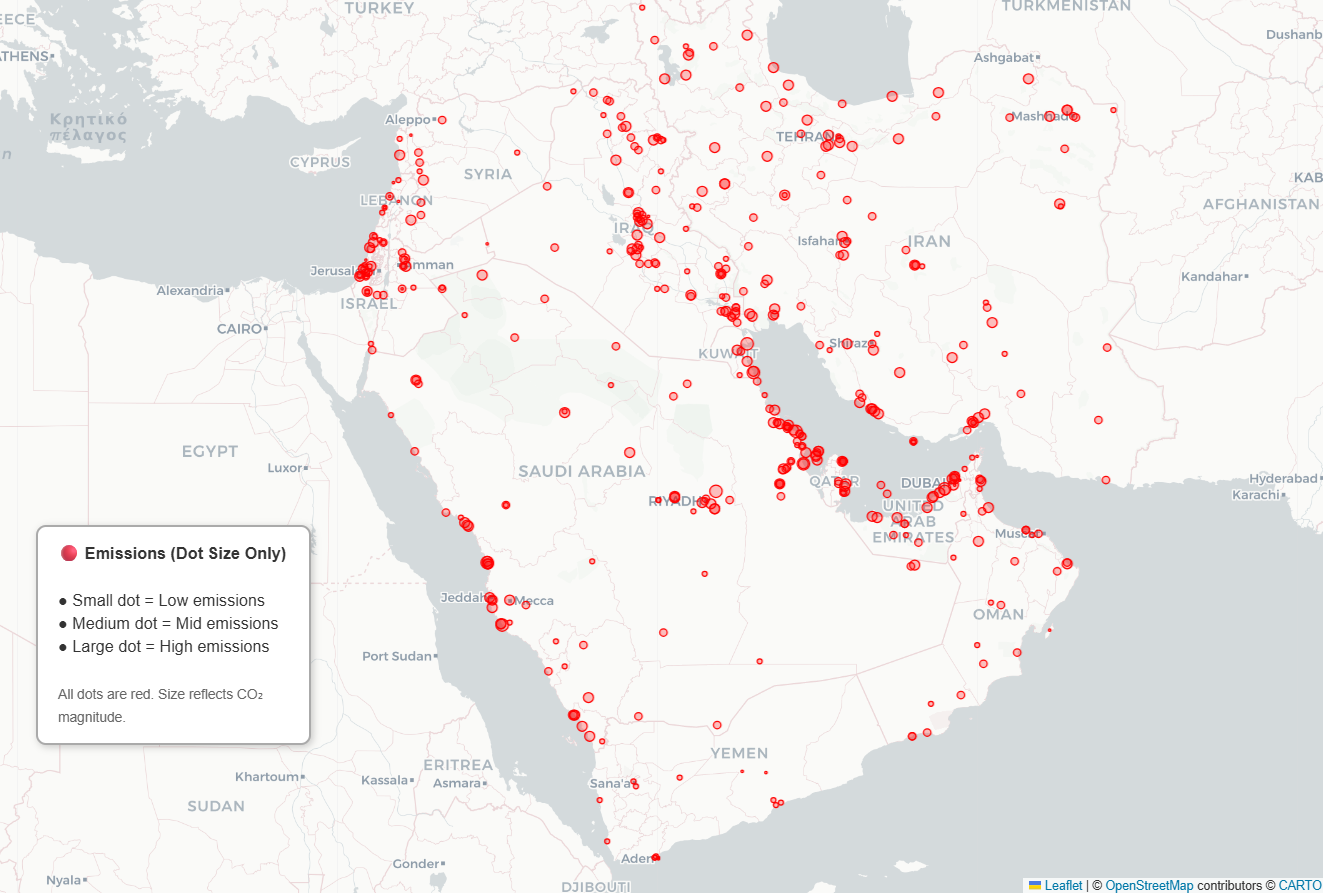
Source: Climate TRACE — Satellite-based GHG emissions imagery. Red circles indicate thermal (fossil-fuel) power plant locations. Circle size correlates with estimated emission intensity. Iran’s facilities are concentrated along the northern plateau and Persian Gulf coast; Gulf state infrastructure clusters densely around Ras Laffan, Abu Dhabi, and Kuwait Bay.
As U.S. threats target Iranian power plants, satellite emissions data reveals the sprawling scale of energy infrastructure across the Middle East — and the cascading risk of a regional blackout.
The U.S. administration has issued a stark ultimatum to the Iranian government: open the Strait of Hormuz — or face direct U.S. strikes on power plants and critical infrastructure across Iran.[1] Visualized here using Climate TRACE’s satellite-derived greenhouse gas emissions data, the map above plots the locations of thermal power plants across the Middle East region.[2] Iran alone operates more than 100 thermal power facilities, while other nations across the broader Middle East collectively account for over 340 such plants — making the region one of the most fossil-fuel-dependent electricity systems on earth.[3] Should Iranian power infrastructure come under attack, retaliatory strikes on energy facilities in neighboring Gulf states are widely anticipated, given Iran’s declared posture of symmetric escalation.[4] As the map makes strikingly clear, power generation assets are particularly dense along the Persian Gulf coastline — in Kuwait, Bahrain, Qatar, the UAE, and southern Iran — meaning any exchange of infrastructure strikes would carry catastrophic consequences for regional electricity supply, desalination capacity, and the global energy markets that depend on Gulf exports.[5]
Insight
The convergence of military escalation and energy geography in the Persian Gulf creates a uniquely fragile moment. With over 440 thermal power plants concentrated across a conflict zone, and the Strait of Hormuz carrying roughly 20% of global seaborne oil trade, the risk of cascading infrastructure collapse extends well beyond Iran’s borders.[6] A regional blackout — triggered by strikes, counter-strikes, or miscalculation — would not only plunge tens of millions into darkness, but could fundamentally destabilize global energy markets at a moment when no viable alternative supply route exists. The satellite data visualized here is not merely a climate accounting tool; it is now a map of geopolitical vulnerability.
Japanese translations
「ホルムズ海峡危機とイランの発電網:中東全域に広がるブラックアウトの連鎖の危機」
米国政権はイラン政府に対し、ホルムズ海峡を開放しなければ発電所を含む重要インフラへの攻撃を行うと警告した。[1] 上図は、Climate TRACEが衛星から取得した温室効果ガス排出データをもとに、中東地域における火力発電所の位置を可視化したものである。[2] イランには100基を超える火力発電所が存在し、中東諸国全体では340基以上の火力発電所が稼働しており、同地域は世界でも有数の化石燃料依存型の電力システムを形成している。[3] 仮にイランの発電インフラが攻撃を受けた場合、イランが表明している対称的エスカレーション方針に基づき、周辺湾岸諸国のエネルギー施設への報復攻撃が広く予想される。[4] 地図が示すとおり、クウェート・バーレーン・カタール・UAE・イラン南部を含むペルシャ湾岸沿岸には発電設備が特に集中しており、インフラへの攻撃が相互に行われた場合、地域の電力供給・海水淡水化能力、さらには湾岸からの輸出に依存する世界のエネルギー市場に対して壊滅的な影響をもたらすリスクがある。[5]
ペルシャ湾岸における軍事的緊張とエネルギー地政学の交差は、極めて脆弱な局面を生み出している。紛争地帯に440基以上の火力発電所が集中し、ホルムズ海峡が世界の海上石油貿易のおよそ20%を担う現状において、インフラ崩壊の連鎖リスクはイランの国境を遥かに超える。[6] 攻撃・報復・あるいは誤算によって引き起こされる地域規模の停電は、数千万人を暗闇に追いやるだけでなく、代替輸送ルートが存在しない今、世界のエネルギー市場を根本から不安定化させる可能性がある。本稿で可視化した衛星データは、もはや単なる気候会計のツールではない——それは地政学的脆弱性の地図である。
References
- Trump, D. (2026, April 6). “Tuesday will be Power Plant Day…” — Truth Social post, as reported by Al Jazeera. Al Jazeera, April 5, 2026; See also: NPR. (2026, April 3). Iran hits Gulf refineries as Trump warns of infrastructure attacks.
- Climate TRACE Coalition. Satellite-derived GHG emissions data, power sector. climatetrace.org
- ScienceDirect / EnergyPLAN model. (2024). Replacing fossil fuel-based power plants with renewables to meet Iran’s environmental commitments. sciencedirect.com; Atlantic Council. (2023). Climate profile: Iran. atlanticcouncil.org
- CNN. (2026, April 7). Live updates: Iran war — Trump warns ‘entire country’ could be taken out. cnn.com
- Wikipedia. (2026). 2026 Strait of Hormuz crisis. en.wikipedia.org
- Wikipedia. (2026). 2026 Iran war. en.wikipedia.org; NPR. (2026, April 6). Iran rejects ceasefire as Trump repeats threat to bomb Iran’s plants. npr.org