


Photo by Ojas Narappenawer on Pexels
Japan’s push to diversify its crude oil supply requires navigating a complex trade‑off between reducing reliance on the Middle East and managing the very different transport distances, costs, crude qualities, and geopolitical risks associated with alternative routes.
Global Shipping Times for Fossil Fuel Transport
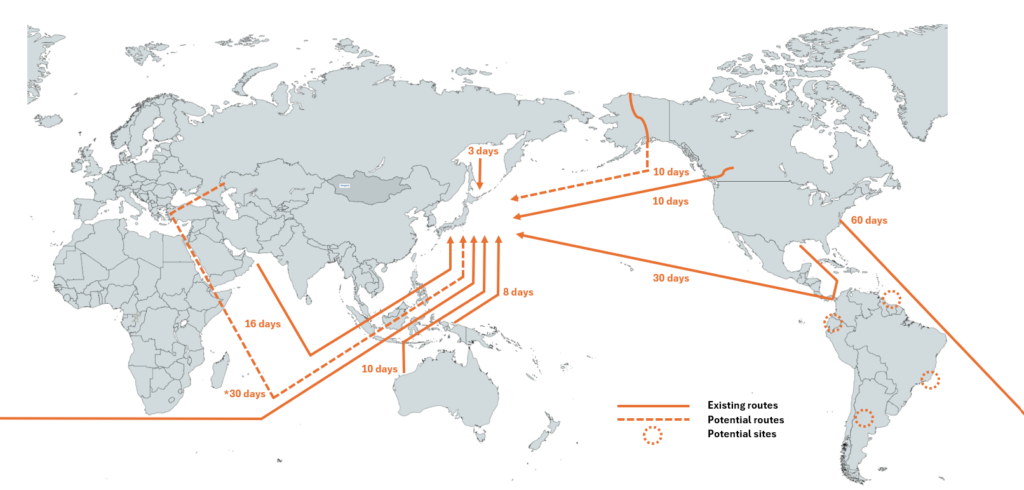
Notes: The map was created using information and data from the Post Petroleum Institutes and Toyo Keizai as of March 25, 2026. The route from Kazakhstan was estimated using AI, and this AI‑generated estimate may contain inaccuracies.
Strategic Implications of Shifting Away from Middle Eastern Oil
The Japanese government is redefining the diversification of crude oil procurement as a central security priority in response to the closure of the Strait of Hormuz. Current diversification options under consideration include crude oil from Kazakhstan in Central Asia, Alaska in the United States, Canada’s Trans Mountain Pipeline, and oil fields in South America, particularly Brazil. According to transport routes and distances identified by specialized agencies, shipments from Central Asia and South America require long-haul transport, which inevitably raises logistics costs as shipping times increase. In contrast, shipments from North America are relatively shorter and therefore offer certain logistical advantages. The comparison makes clear that reducing dependence on the Middle East lowers geopolitical exposure, but it also requires Japan to rely on supply routes that differ significantly in cost, transit time, and operational risk.
Regional differences in crude oil quality and associated costs also warrant attention. In North America, Alaskan crude is a medium-grade oil well suited to Japan’s refining infrastructure, yet its transport cost—estimated at 2 to 3.5 dollars per barrel—offers only limited advantage compared with Middle Eastern crude, which ranges from 1.75 to 3.35 dollars. Canadian crude is predominantly high‑sulfur heavy oil, implying higher desulfurization and refining costs. Brazil, though politically stable and a producer of substantial volumes of medium-grade crude, faces cost pressures from long-distance transport, including higher inventory requirements and increased insurance premiums. Kazakhstan produces medium to light crude, but as a landlocked country it relies on complex transport routes via the Caspian Sea, the Caucasus, the Mediterranean, the Suez Canal, and the Red Sea—routes that expose shipments to multiple layers of geopolitical risk.
Crude Oil Classification by API Gravity and Sulfur Content
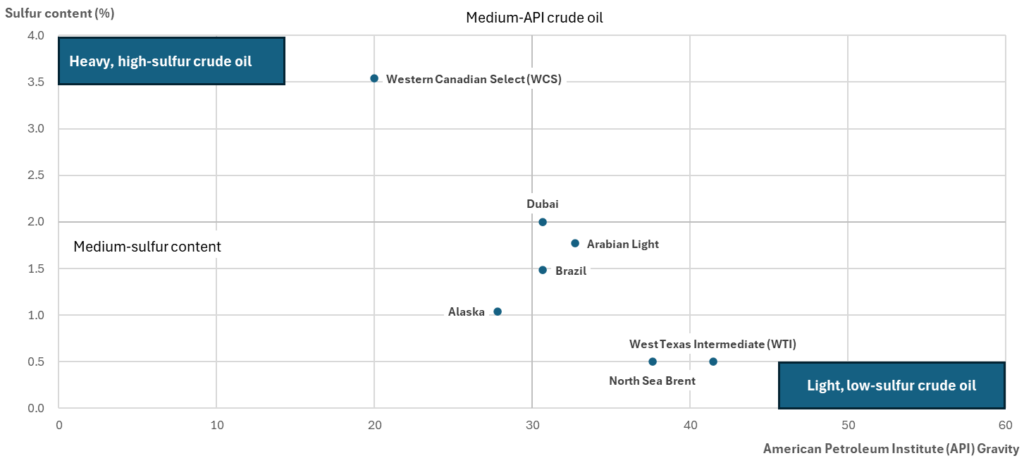
Notes: The chart is based on data from the Post Petroleum Institute and the U.S. Energy Information Administration, as of March 25, 2026.
Taken together, these factors indicate that Japan’s crude oil diversification strategy requires careful balancing across three dimensions: supply security, cost and distance constraints, and geopolitical exposure. Analysis of transport routes and associated risks suggests that future diversification efforts must go beyond simply expanding the number of suppliers and instead incorporate an integrated assessment of crude oil characteristics, refining compatibility, logistics costs, and geopolitical risk.
Japanese Translations
中東依存低減がもたらす戦略的含意
日本政府は、ホルムズ海峡の封鎖を受けて、原油調達先の多角化を安全保障上の最重要課題として再定義しつつある。現在、検討されている多角化先には、中央アジアのカザフスタン、米国アラスカ州、カナダのトランス・マウンテン・パイプラインに加え、ブラジルを中心とする南米の油田が含まれる。専門機関が示す輸送ルートと距離を踏まえると、中央アジアや南米からの輸送は長距離となり、輸送日数の増加に伴って物流コストが上昇することは避けられない。一方、北米からの輸送は相対的に距離が短く、一定の物流面での優位性があると考えられる。こうした比較から、中東依存を低減することには地政学的リスクの縮小という利点があるものの、代替ルートはコスト、輸送時間、運用リスクが大きく異なり、供給システム全体に新たな不確実性をもたらすことが明らかになる。
地域別の原油の性状と追加コストも重要な検討要素となる。北米では、アラスカ原油は中質油で日本の精製設備との適合性が高いものの、その輸送コストは1バレルあたり2〜3.5ドルと推計され、中東産原油(1.75〜3.35ドル)と比べて優位性は限定的である。カナダの原油は高硫黄の重質油が中心であり、脱硫・精製コストの増加が見込まれる。ブラジルは政治的に比較的安定し、中質油の産出量も多いが、長距離輸送に伴う在庫水準の引き上げや保険料の増加がコスト構造に影響を与える。カザフスタンは中質〜軽質油を産出するものの、内陸国であるため、カスピ海、コーカサス、地中海、スエズ運河、紅海を経由する複雑な輸送ルートに依存し、複数の地政学リスクにさらされる。
これらを総合すると、日本の原油調達多角化は「供給の安全保障」「コスト・距離の制約」「地政学リスク」という三つの軸の間で精緻なバランスを求められる政策領域であることがわかる。輸送ルートと関連リスクの分析は、今後の多角化戦略において、単なる調達先の拡大ではなく、原油の性状、精製適合性、物流コスト、地政学リスクを統合的に評価する必要性を示唆している。