


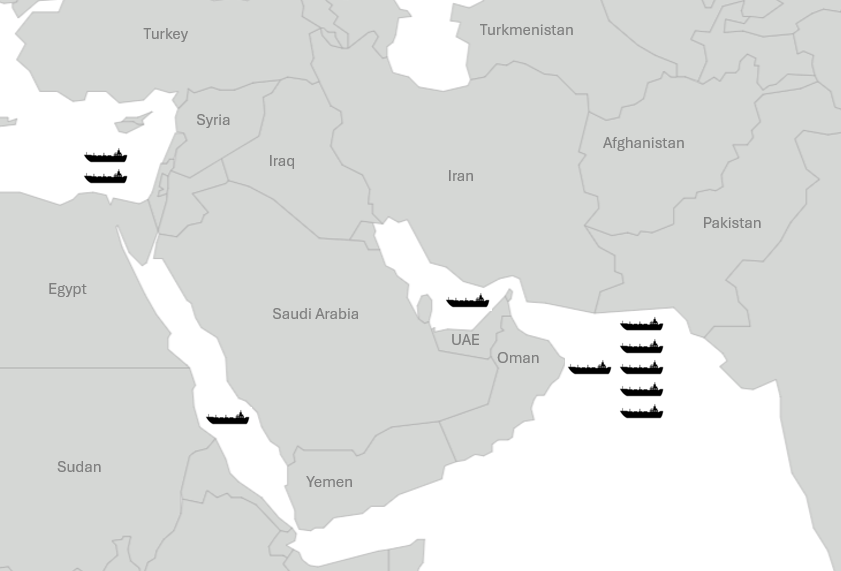
The map above was recreated by the author based on the Fox News article “US-Iran nuclear talks resume as both sides prepare militarily.”
More than 90% of Iran’s $109.7 billion annual trade flows through the Strait of Hormuz. The U.S. counter-blockade does not merely restrict a trade route — it severs the circulatory system of an entire economy.
Analysis
Iran’s vulnerability to the U.S. counter-blockade is structural rather than situational. Over 90% of the country’s $109.7 billion in annual trade transits the Strait of Hormuz,1 with petroleum accounting for approximately 80–83% of total export value, of which roughly 90% flows through the 33-kilometre narrows between Iran and Oman.2 Non-oil exports — minerals, metals, petrochemicals, textiles — add a further $88 million in daily shipments, of which an estimated 90% is equally exposed.1 The only credible bypass, the Jask terminal on the Gulf of Oman coast, operates at approximately 70,000 barrels per day against an export base of 1.7–1.8 million bpd: roughly 4% coverage.3 The war that began on February 28, 2026 initially appeared to hand Tehran a windfall — by controlling the strait and charging transit fees exceeding $1 million per vessel, while a 40% rise in global oil prices inflated the value of every barrel it did export, Iran’s oil revenues surged in the first six weeks of the conflict.4 That paradox inverted sharply on April 13, when the U.S. Navy established its blockade line at its exit in the Gulf of Oman and the Arabian Sea. Within 24 hours, no ships had broken through; within 48 hours, 13 vessels had turned back.5 Enforcement is underpinned by a surveillance architecture — satellite imagery, drone overflights, AI-assisted hull identification — that makes AIS-dark evasion difficult to sustain at scale, and CENTCOM has confirmed that vessels which departed Iranian ports before the blockade took effect remain subject to interdiction anywhere in international waters, including the Pacific area of responsibility.6 The combined economic damage is estimated at $435 million per day, or approximately $13 billion per month.1
The same chokepoint that briefly generated toll income for Tehran is now the mechanism of its economic strangulation — at a rate of $435 million per day.
Conclusion
Iran’s economy is architecturally imprisoned by the Strait of Hormuz. The country spent years treating the strait as a geopolitical weapon — a threat it could brandish to deter adversaries and extract concessions. The U.S. counter-blockade has exposed the double-edged nature of that dependency: the same chokepoint that gave Iran leverage is now the instrument of its economic isolation. With no bypass route capable of handling meaningful volume, a counter-blockade is not merely a pressure tactic — it is, in economic terms, a near-total severance of Iran’s revenue base. The financial clock is running at a rate of roughly $435 million per day. Whether that arithmetic is sufficient to bring Tehran to a durable negotiated settlement — or whether it hardens resolve and triggers escalation — remains the defining open question of the current standoff.
Japanese translations
イランの貿易はホルムズ海峡に構造的に全依存している。
年間1,097億ドルにのぼるイランの貿易総額の90%以上が同海峡を経由しており1、石油輸出収益はイラン政府歳入の85%前後を占める2。唯一の代替ルートであるジャスク・ターミナルの処理能力は輸出量の4%程度に留まり3、実効的な迂回路は存在しない。2026年2月28日の開戦直後、イランはホルムズ海峡の通行料(1隻あたり100万ドル超)徴収と原油価格の約40%高騰により一時的に収益を拡大させたが4、米海軍はホルムズ海峡の出口にあたるオマーン湾・アラビア海に封鎖線を設定することで状況を反転させた。封鎖開始から24時間で突破船はゼロ、48時間で13隻が引き返した5。衛星・ドローン・AIによる船体識別を組み合わせた監視網はAIS無効化による迂回を困難にしており、封鎖は太平洋海域にも適用が拡大されている6。推計では封鎖による経済的損失は1日4億3,500万ドル、月間では約130億ドルに達する1。かつて地政学的切り札だった海峡は、今やイラン経済を締め上げる枷となっている。この経済的圧力が最終的にイランを交渉の席に引き寄せるか、それとも事態のエスカレーションをもたらすかが、現在の対立における最大の焦点である。
References
The cover map was recreated by the author based on the Fox News article titled “US-Iran nuclear talks resume as both sides prepare militarily.”
[1] Iran International (2026, April 14). What the US naval blockade would mean for Iran’s economy.
Over 90% of Iran’s $109.7 billion annual trade transits the Strait of Hormuz; an estimated $435 million per day would be blocked, amounting to roughly $13 billion per month in economic disruption. The Jask terminal handles approximately 70,000 barrels per day.
[2] Strauss Center for International Security and Law, University of Texas. Strait of Hormuz — Iran and Oil.
Approximately 90% of Iranian oil exports pass through the Strait of Hormuz (around 83% of all exports). Oil revenues constitute roughly 85% of government income.
[3] Iran International (2026, April 14), op. cit.
The Jask terminal’s ~70,000 bpd capacity represents only about 4% of Iran’s 1.7–1.84 million bpd export rate (Kpler, April 2026).
[4] Al Jazeera (2026, April 14). How much will US Hormuz blockade hurt Iran?
Iran earned roughly 40% more from oil in the first six weeks of 2026; exports reached 1.84 million bpd in March 2026 (Kpler). Transit fees exceed $1 million per vessel.
[5] USNI News (2026, April 14). Strait of Hormuz Traffic Down as U.S. Blockade Appears to Deter Some Ships.
Thirteen vessels turned back within 48 hours; AIS‑dark ships were identified using hull geometry. More than 10,000 U.S. personnel and over a dozen warships were involved.
[6] Stars and Stripes (2026, April 16). US forces expand scope of the blockade.
Gen. Dan Caine confirmed the blockade now extends into the Pacific area of responsibility; contraband categories include crude oil, refined products, weapons, nuclear materials, and metals.