



Photo by Su San Lee on Unsplash
An analysis of Japan’s greenhouse gas emissions from 2013 to 2040 in light of NDC targets.
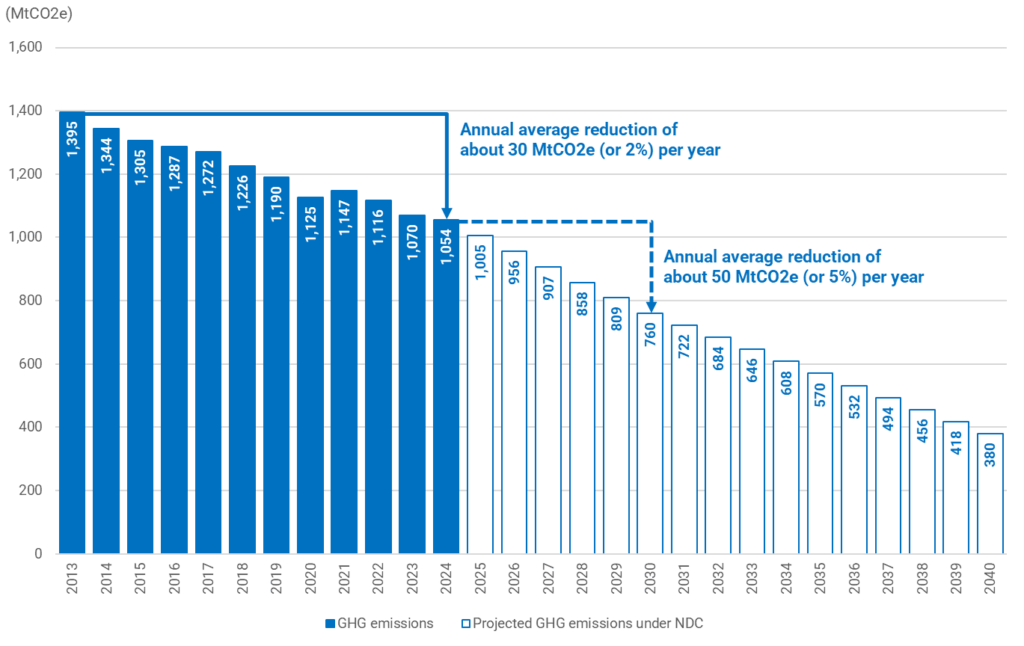
According to newly released data from the National Institute for Environmental Studies (NIES), Japan’s greenhouse gas (GHG) emissions stood at 1,054 MtCO₂e in 2024 — down from the 2013 NDC base year of 1,395 MtCO₂e, representing an average annual reduction of approximately 2%, or roughly 30 MtCO₂e per year.FN1 This trajectory, while meaningful, falls significantly short of what is required to meet Japan’s climate commitments. To achieve the 2030 Nationally Determined Contribution (NDC) target, Japan must accelerate to an average annual reduction rate of 5% — equivalent to cutting about 50 MtCO₂e every year from today’s level.FN2 Beyond 2030, the ambition grows steeper still: the 2040 pathway requires roughly halving the 2030 emissions level, pushing total national emissions toward approximately 380 MtCO₂e.FN3
Japan’s Total GHG Emissions and Reduction Outlook (2013–2040)
Source: National Institute for Environmental Studies (NIES), Japan April 2026
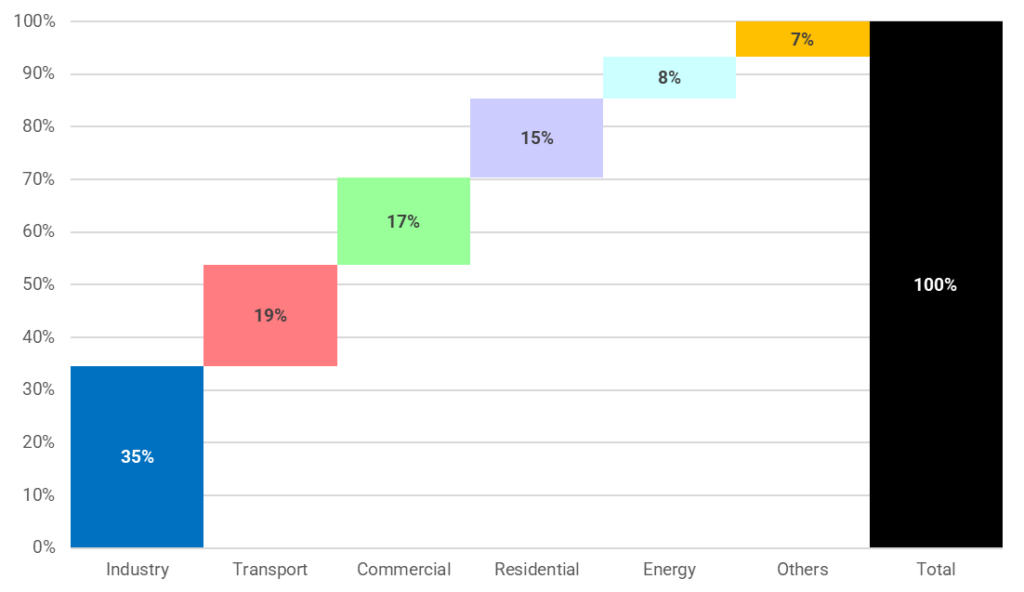
A sectoral breakdown reveals where the challenge is most acute. Industry remains by far the largest emitter, accounting for 35% of Japan’s total GHG output, followed by transport (19%), commercial (17%), residential (15%), and energy (8%).FN1
Sectoral Composition of Japan’s GHG Emissions
Source: National Institute for Environmental Studies (NIES), Japan April 2026
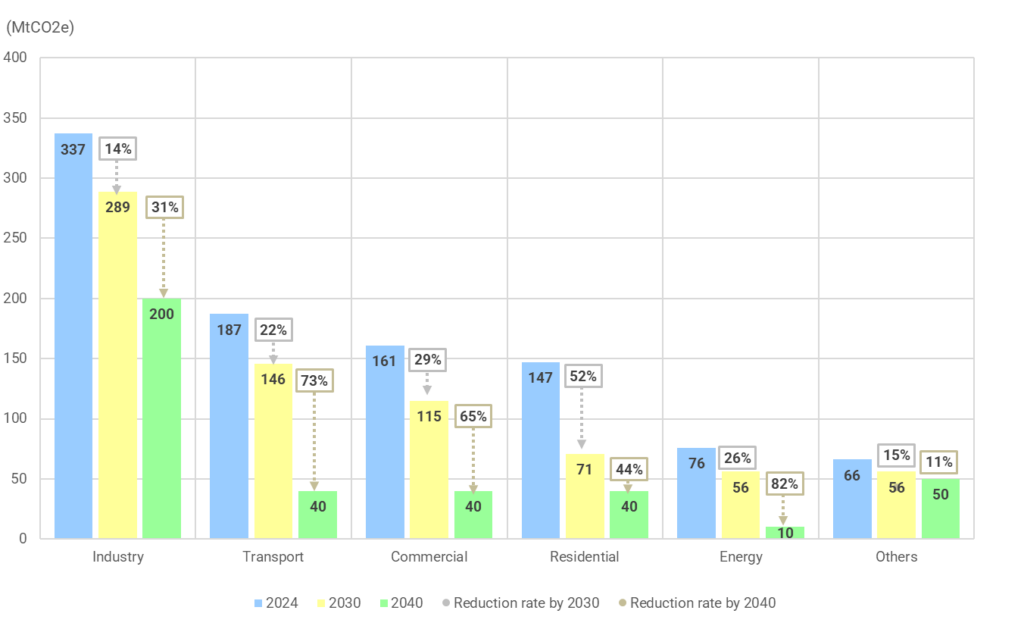
NIES projections indicate that under the NDC scenario, industry emissions must fall from 337 MtCO₂e in 2024 to 200 MtCO₂e by 2040 — a 40% reduction — while transport faces a reduction of over 70% by 2040 (from 187 to 40 MtCO₂e).FN2 Residential emissions present an immediate benchmark: the 2030 NDC target already demands a roughly 50% cut from 2024 levels (from 147 to around 71 MtCO₂e), making the household sector a near-term litmus test for Japan’s decarbonisation credibility.FN3
Projected Emission Reductions by Sector (2024–2040)
Source: National Institute for Environmental Studies (NIES), Japan April 2026
Japan has demonstrated a decade-long commitment to steady emissions reduction, averaging 2% annually since 2013. However, the data make clear that a fundamental step-change in policy ambition and implementation speed is now unavoidable.FN1 The gap between the current 2% trajectory and the 5% annual reduction required for the 2030 NDC — let alone the near-halving needed by 2040 — is not a marginal adjustment but a structural transformation.FN2 Without decisive policy intervention, including robust carbon pricing, sectoral mandates, and large-scale green investment, Japan risks falling significantly short of both its 2030 and 2040 climate targets, undermining its international credibility and long-term energy security.FN3
Japanese translations
日本の温室効果ガス削減の軌跡:進展はあるが、道のりは険しい
国立環境研究所(NIES)が新たに公表したデータによると、日本の温室効果ガス(GHG)排出量は2024年に1,054 MtCO₂eとなり、NDCの基準年である2013年の1,395 MtCO₂eから減少した。これは年平均約2%(約30 MtCO₂e/年)の削減ペースに相当する。FN1 この軌道は一定の前進を示すものの、日本の気候目標の達成には遠く及ばない。2030年のNDC目標を達成するためには、年平均5%、すなわち現在の水準から毎年約50 MtCO₂eを削減するペースへの加速が不可欠である。FN2 さらに2040年の目標は一層野心的であり、2030年の排出量水準をさらに半減させ、国全体の排出量を約380 MtCO₂eまで抑制することが求められる。FN3
部門別の分析は、課題が最も深刻な分野を明確に示している。産業部門は日本の総排出量の35%を占める最大の排出源であり、次いで運輸(19%)、商業(17%)、家庭(15%)、エネルギー(8%)と続く。FN1 NIESの推計によれば、NDCシナリオの下で産業部門の排出量は2024年の337 MtCO₂eから2040年には200 MtCO₂eへと約40%削減される必要があり、運輸部門は2040年までに70%超(187から40 MtCO₂eへ)の削減が求められる。FN2 家庭部門は近い将来の試金石となる。2030年NDC目標の達成のためには現時点からすでに約50%の削減(147から約71 MtCO₂eへ)が必要であり、日本の脱炭素化の信頼性を問う直近の指標となっている。FN3
Industry / 産業
日本は2013年以降、年平均2%という着実な排出削減を10年以上にわたり継続してきた。しかし、データが明確に示すのは、政策の野心と実施速度における根本的な転換が今や避けられないという現実である。FN1 現行の2%軌道と2030年NDCに必要な年5%削減との乖離は、わずかな調整ではなく、経済・社会構造全体の変革を要する課題であり、2040年の半減目標はさらにその先を求める。FN2 炭素価格付け、部門別規制、大規模グリーン投資といった決定的な政策介入なしには、日本は2030年・2040年双方の気候目標を大幅に下回るリスクを抱え、国際的な信頼性と長期的なエネルギー安全保障をも損なうこととなる。FN3
References / 参考文献
English
FN1 National Institute for Environmental Studies (NIES), Japan’s Greenhouse Gas Emissions Data (2013–2024), Official Statistical Release, 2026. Includes sectoral breakdown by industry, transport, commercial, residential, and energy.
FN2 Government of Japan, Japan’s Nationally Determined Contribution (NDC) — Updated 2030 Target, Submission to UNFCCC, 2022. Specifies a 46% reduction in GHG emissions by FY2030 relative to FY2013, with an aspirational 50% target.
FN3 Ministry of the Environment, Japan / Ministry of Economy, Trade and Industry (METI), Green Transformation (GX) Basic Policy and 2040 Decarbonisation Roadmap, 2023–2024. Outlines sectoral pathways and investment requirements toward net‑zero by 2050, including interim 2040 milestones.
日本語
FN1 国立環境研究所(NIES)『日本の温室効果ガス排出量データ(2013〜2024年)』公式統計公表資料、2026年。産業・運輸・商業・家庭・エネルギー等の部門別内訳を含む。
FN2 日本政府『日本の国が決定する貢献(NDC)——2030年目標(更新版)』UNFCCC提出書類、2022年。2030年度に2013年度比46%削減(50%削減を目指す)を規定。
FN3 環境省・経済産業省(METI)『GX(グリーントランスフォーメーション)基本方針及び2040年脱炭素ロードマップ』2023〜2024年。2050年カーボンニュートラルに向けた部門別経路と投資要件、2040年中間目標を示す。