



Photo by Markus Winkler on Unsplash
From carbon capture to green ammonia — what the quantum-AI revolution could mean for the planet.
To understand why quantum computing matters for climate, it helps to start from scratch. An ordinary computer — the kind in your laptop or phone — stores information as bits: each one is either 0 or 1, like a light switch that is either off or on. A quantum computer uses qubits, which can be 0, 1, or both at the same time (a property called superposition). Qubits can also be “entangled,” meaning the state of one instantly influences another, no matter the distance. The result: a quantum computer can explore an astronomically large number of possibilities simultaneously, rather than one at a time.
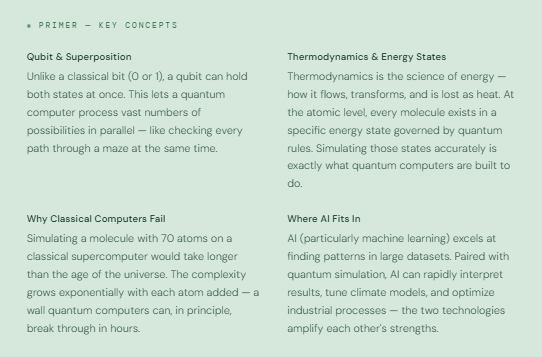
Quantum computers — machines that exploit superposition and entanglement to process information at scales classical hardware cannot approach — are increasingly positioned as a breakthrough tool in the fight against climate change, especially when combined with AI. Their core advantage lies in molecular simulation: because nature itself operates by quantum rules, a quantum computer can model atoms and energy states directly, without approximation. This is the link to thermodynamics — understanding how energy behaves at the molecular level is the key to designing better catalysts, materials, and industrial processes. It is precisely in these areas where, as a recent deep-dive on the topic shows, humanity has simply “given up” due to computational limits.[1]
“Nature isn’t classical, dammit, and if you want to make a simulation of nature, you’d better make it quantum mechanical.”— Richard Feynman, 1982
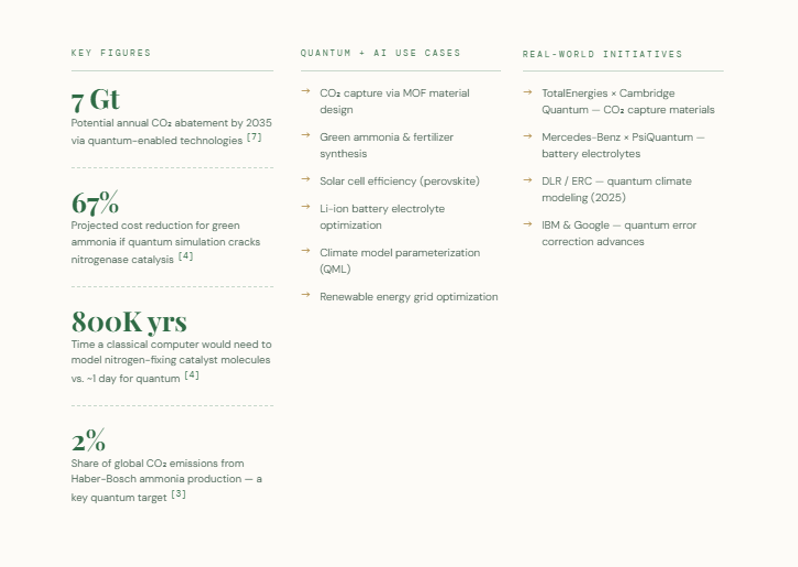
Three application areas stand out. First, CO₂ capture: no cheap, scalable catalyst for direct air capture exists today; quantum simulation of metal-organic frameworks (MOFs) could unlock materials that scrub carbon from the atmosphere at industrial scale, an avenue already being explored by TotalEnergies and Cambridge Quantum Computing.[2] Second, green ammonia and fertilizers: the century-old Haber-Bosch process accounts for roughly 2% of global CO₂ emissions;[3] modeling the nitrogenase enzyme that bacteria use to fix nitrogen at room temperature could yield an artificial catalyst that cuts production costs by 67% — a task that would take a classical computer over 800,000 years but a quantum machine a single day.[4] Third, energy storage and renewables: stagnating lithium-ion battery energy density and solar cells running at barely half their theoretical efficiency both represent problems of molecular design; quantum simulation of perovskite crystal structures and battery electrolytes — already pursued by Mercedes-Benz and PsiQuantum — could break both logjams.[5] Beyond chemistry, quantum machine learning is being applied to climate modeling itself, with a 2025 paper from DLR and the European Research Council showing that even today’s noisy quantum devices can improve representation of sub-grid atmospheric phenomena such as cloud formation and turbulence.[6] McKinsey estimates that, across all these vectors, quantum-enabled climate technologies could contribute up to 7 gigatons of additional CO₂ abatement per year by 2035 — enough to put the 1.5 °C target back within reach.[7]
Conclusion
Quantum computing is not a magic solution, but it may be the key that unlocks several doors classical computing has left permanently shut. The most transformative near-term path runs through molecular simulation — designing the catalysts, materials, and processes that underpin carbon capture, clean fuels, and next-generation storage. Real-world partnerships are already forming, and the roadmap is credible. The caveat is timing: million‑qubit, fault‑tolerant systems needed for the hardest problems remain years away, and the environmental footprint of quantum hardware itself warrants scrutiny.[8] A dual strategy — sustained quantum R&D investment alongside continued classical and AI‑driven progress — is the most rational response to the urgency of the climate crisis, and the only one capable of keeping pace with it.
Japanese translations
量子コンピュータは気候危機を解決できるのか
量子コンピュータは、ビットではなく「量子ビット(qubit)」を使い、 重ね合わせや量子もつれといった性質を利用することで、 従来のコンピュータでは不可能な規模の組み合わせを同時に探索できる。この特性は、気候変動対策における分子シミュレーションに特に有効だ。 自然界そのものが量子力学で動いているため、量子コンピュータは 触媒・材料・エネルギー状態を近似なしで直接計算できる。
その結果、以下の3分野で大きなインパクトが期待されている:
① CO₂回収(DAC)
- 大気中CO₂を安価に吸着できる触媒はまだ存在しない
- 量子シミュレーションにより、MOF(多孔性材料)の設計が飛躍的に進む可能性
- TotalEnergies や Cambridge Quantum がすでに研究を開始
② グリーンアンモニア・肥料
- ハーバー・ボッシュ法は世界のCO₂排出の約2%を占める
- バクテリアが使う「ニトロゲナーゼ酵素」を量子計算で再現できれば、 室温で窒素固定できる人工触媒が実現し、 コスト67%削減の可能性
- 古典コンピュータでは80万年かかる計算が、量子なら1日で可能とされる
③ エネルギー貯蔵・再エネ
- リチウムイオン電池のエネルギー密度は頭打ち
- 太陽電池も理論効率の半分程度に留まる
- 量子シミュレーションで
- ペロブスカイト結晶構造
- 電池電解質 を最適化することでブレークスルーが期待される
- Mercedes-Benz や PsiQuantum がすでに研究中
④ 気候モデル(量子機械学習)
- DLR・ERCの2025年研究では、 現在のノイズあり量子デバイスでも雲形成や乱流などのサブグリッド現象の表現を改善できると報告
⑤ 量子×気候の総合インパクト
McKinsey の試算では、量子技術が2035年までに 最大7ギガトンの追加CO₂削減に寄与し得るとされ、 1.5℃目標を再び射程に戻す可能性がある。
🔍 結論(要点)
- 量子コンピュータは万能ではないが、 古典計算では永久に解けない問題の扉を開く鍵になり得る。
- 特に分子シミュレーションは、 CO₂回収、クリーン燃料、次世代電池の基盤技術を変える可能性が高い。
- ただし、
- 100万量子ビット級の誤り耐性マシンはまだ数年先
- 量子ハードウェア自体の環境負荷も検証が必要
- したがって、 量子R&Dの継続投資と、古典+AIの進化を同時に進める「二重戦略」は、気候危機のスピードに追いつける唯一の道かもしれない。
References
[1]World Economic Forum, “Quantum Computing for Innovative Climate Change Solutions,” Dec 2019. A 70-atom simulation would exceed the age of the universe on classical hardware. Also see TBS Cross Dig, ”【技術革新で未来が数十年近づいた】量子コンピューターを開発製造するQuEra Computing,Presidentの北川拓也/日本の産業がいち早く使うべき【CROSS DIG 1on1】,” May 2025.
[2]Riverlane, “How Quantum Computing Can Help Tackle Climate Change,” 2021; Greene-Diniz et al., “Modelling carbon capture on metal-organic frameworks with quantum computing,” arXiv:2203.15546, 2022.
[3]Riverlane (op. cit.); Haber-Bosch consumes 3–5% of world natural gas and generates ~2% of global CO₂ annually.
[4]McKinsey & Company, “Quantum computing just might save the planet,” May 2022; Boston Consulting Group R&D initiative cited in Riverlane (op. cit.).
[5]Ricciardi Celsi & Ricciardi Celsi, Energies, 2024, cited in The Quantum Insider, May 2024; perovskite theoretical efficiency ~40% vs. ~20% for current silicon cells.
[6]Schwabe, M. et al., “Opportunities and challenges of quantum computing for climate modelling,” Environmental Data Science, 2025, 4:e35. DOI: 10.1017/eds.2025.10010
[7]McKinsey & Company (op. cit.). Estimate covers carbon capture, green fuels, batteries, fertilizers, and solar combined.
[8]Cambridge Core, “How might quantum computing impact climate change?” Research Directions: Quantum Technologies, Feb 2025. Flags lifecycle carbon footprint and timing risks.